
Everyone on LinkedIn Is a Sourcing Agent Now — Here's How to Spot the Ones Who Actually Know Anything
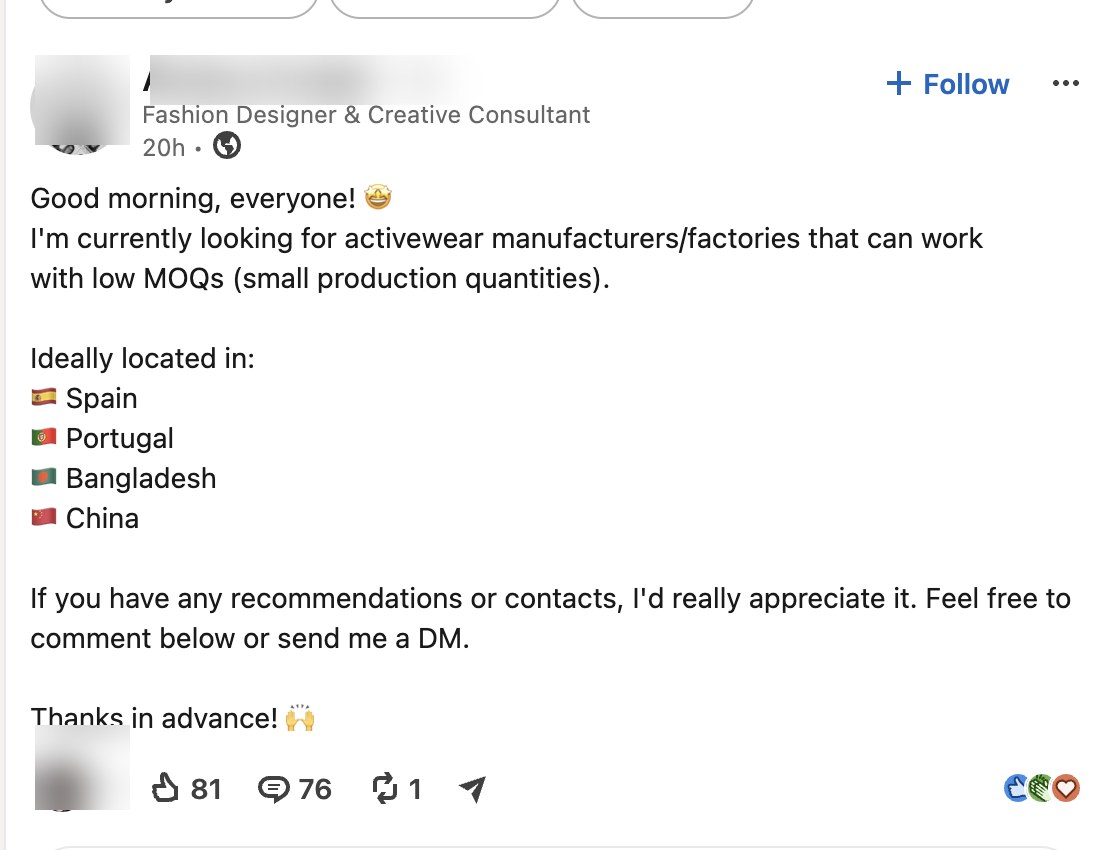
Yesterday on LinkedIn I watched someone post a fairly ordinary request: they were looking for activewear manufacturers that could handle small MOQs, ideally in Spain, Portugal, Bangladesh or China. Twenty hours later the post had 81 reactions, 76 comments, and something like 40 different people — spread across a dozen countries — offering to be their sourcing agent, their manufacturer, their factory contact, or their "partner from concept to production."
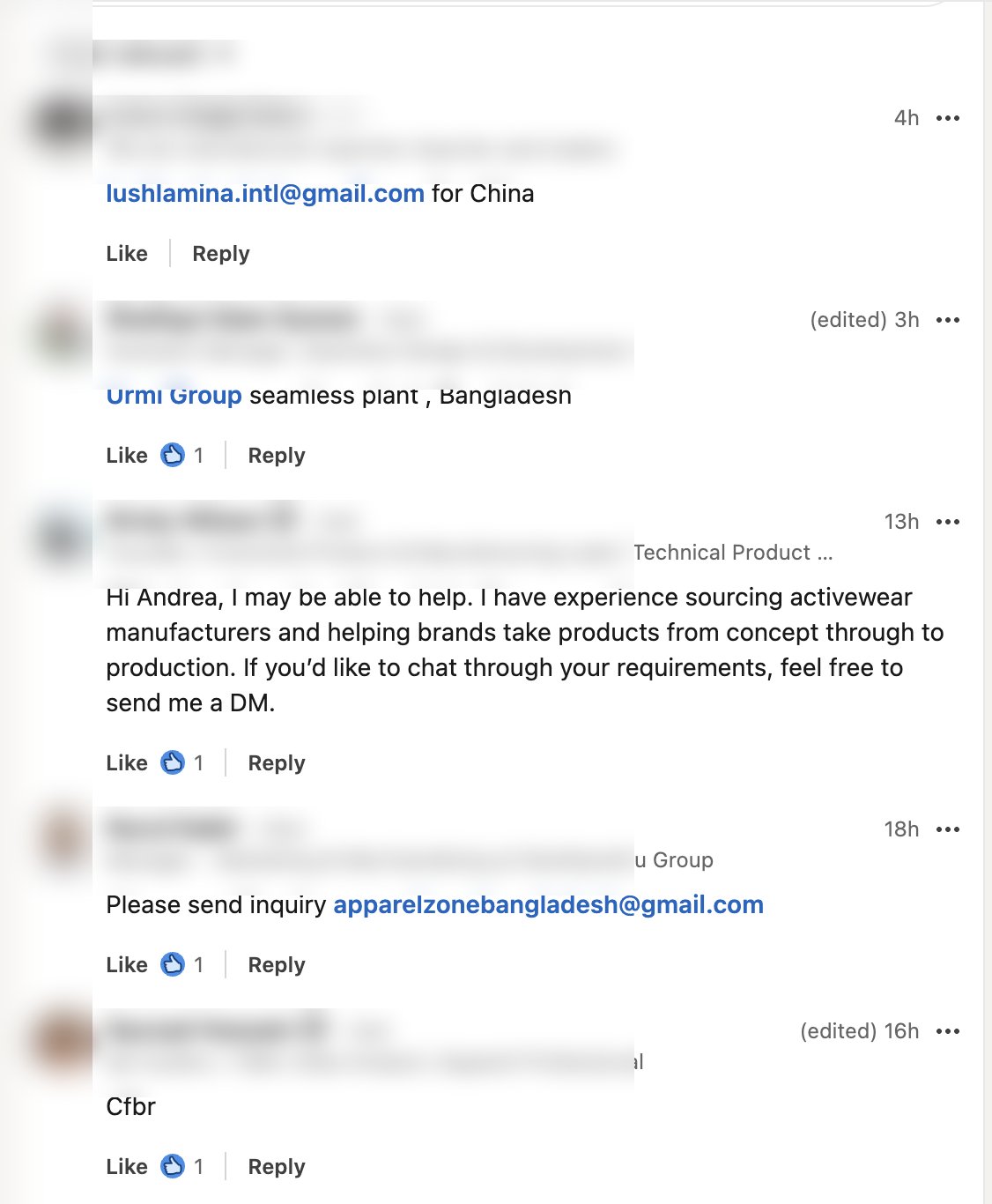
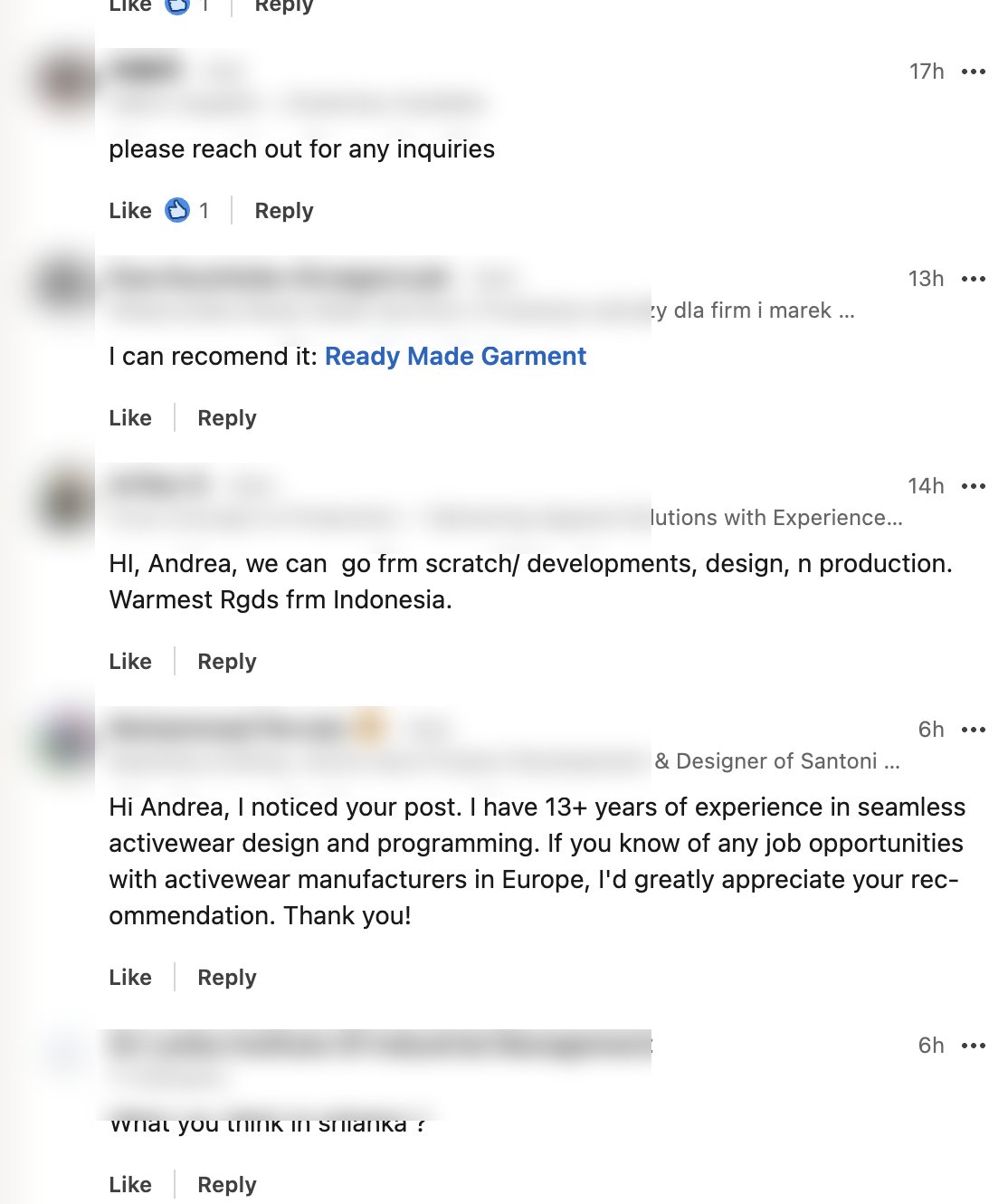
Most of them had never met the poster. Half didn't seem to have read past the word "activewear." One replied "Cfbr" — internet shorthand for "commenting for boosted reach", i.e. bumping the post so other people see it. Several sent a Gmail address and a WhatsApp number. One suggested Sri Lanka. One suggested India. A dozen said some variant of "hi, I have experience, DM me."
This is the state of sourcing on LinkedIn in 2026 — not just for China, but for every low-cost manufacturing country that ends up in the same sentence. The barrier to calling yourself a sourcing agent is zero. The barrier to actually being one — the kind who saves you money instead of losing you tens of thousands of dollars — hasn't changed. And the gap between the two has never been wider.
Look at the shape of who's replying. This isn't a targeted request from someone with domain knowledge. It's a self-selected free-for-all: anyone in the world with a LinkedIn account and 30 seconds to type "hi Andrea." Nobody's checking whether the poster's product actually fits their factory. Nobody's asking about volumes, fabrics, price target, or timeline. They're just… replying.
This is the part that matters if you're the person posting: a wall of eager replies is not the same as a wall of qualified replies. A cheap price from someone who will "definitely help" is not a signal you found a good supplier. It's a signal that the market is flooded with people who will jump on any inquiry — even one that's obviously below their real MOQ, in a category they don't actually run, in a country the buyer didn't ask about.
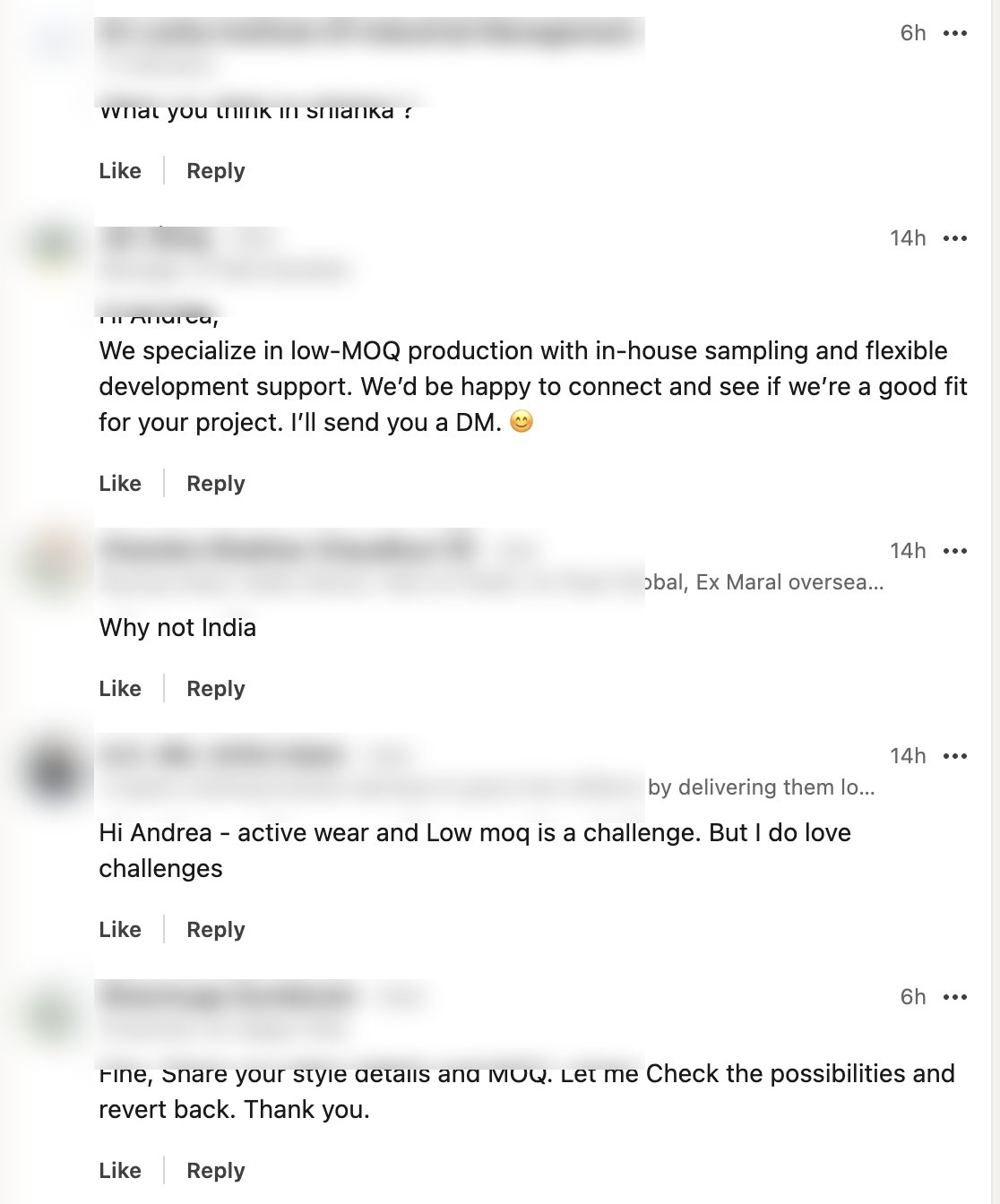
The dangerous thing about a comment thread like this is that it feels like abundance. Forty people offering help must mean at least a few of them are great, right? Sometimes. But the same dynamics that produced 40 replies also produce a strong selection bias: the people who reply fastest and hardest are the ones with the most spare time, which correlates poorly with actually being busy running a good supplier operation. Nine of these forty are Gmail addresses. Half don't specify a product category. None of them have asked a real question.
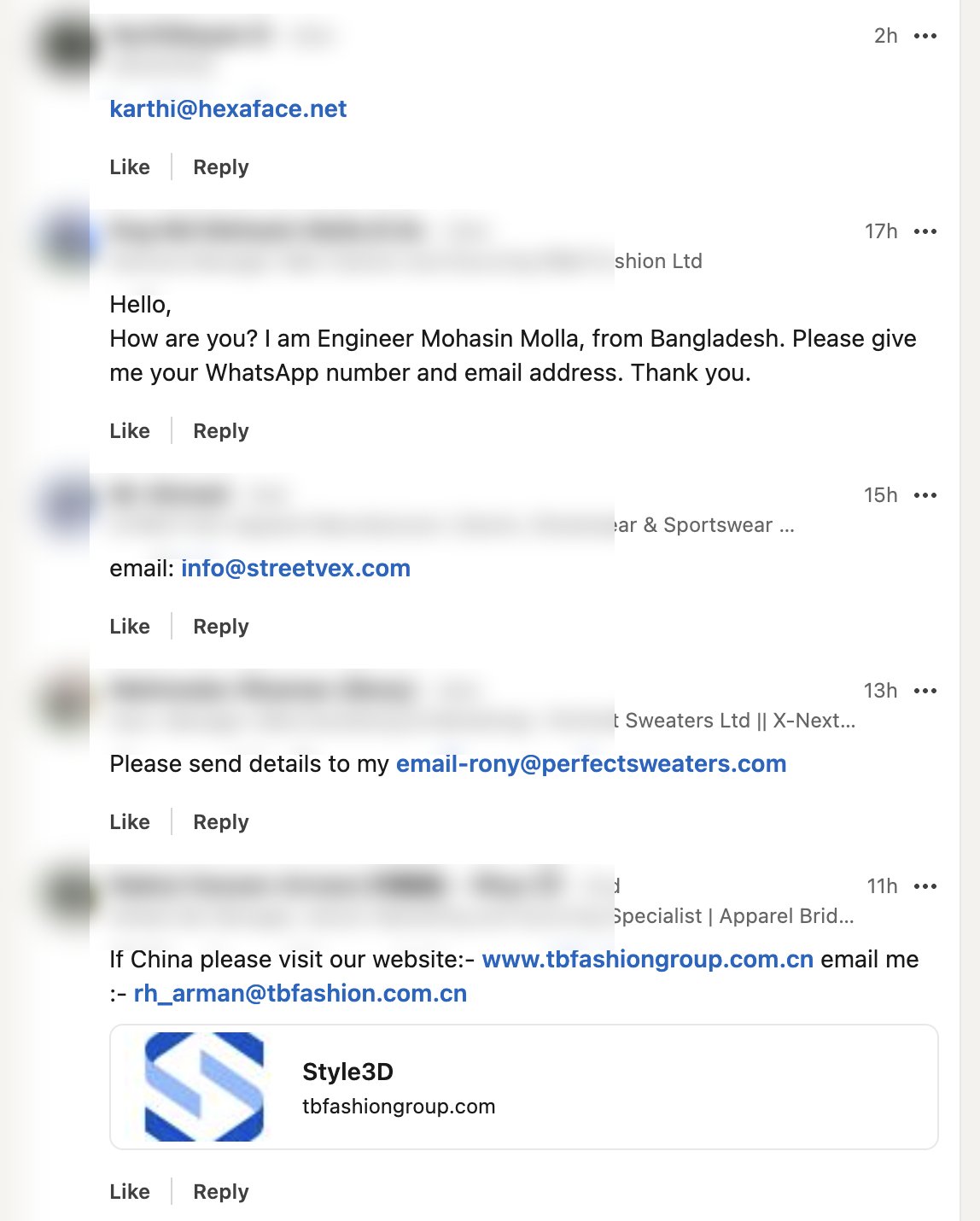
And here's the trap: at least a few of these people will quote a price that looks great. Some will look like real factories. Some are real factories, just wrong for the job. A cheap unit price at the wrong MOQ, in the wrong fabric, with no QC oversight, is more expensive than a slightly higher price from a supplier who actually fits. Every experienced importer has been through the version of this where the "cheapest" quote turned into a $20k mistake once samples arrived, or once the first container shipped, or once the supplier stopped answering messages halfway through production.
The five kinds of "sourcing agent" you're actually talking to
Not everyone answering these posts is bad. Some of them are excellent. But the pool has a shape, and it's worth knowing what's in it before you send anyone your product specs.
1. The recently-laid-off. Six months ago they were an assistant merchandiser or a QC at a real factory. They know a lot about one product category and almost nothing outside it. They can be genuinely useful if what you need happens to overlap with their old job, and a liability if it doesn't — because they'll take the work anyway.
2. The English teacher pivoting. They live in Shenzhen or Guangzhou, they speak decent Mandarin, and they saw someone on Twitter making $8k/month from sourcing. They have no factory contacts, no product knowledge, and no idea what a CIQ certificate is. They will find you a supplier on 1688 (which you could have found yourself) and mark it up 20%.
3. The foreigner running it from Bali. Never been to your factory. Never been to any factory. Everything they do is over WeChat with a "partner in Shenzhen" who is usually one of the two categories above. When something goes wrong, no one on their side can physically show up.
4. The AI post-farmer. They exist mostly on LinkedIn. Their profile is full of em-dashes, "In my years of sourcing…" openers, listicles with suspiciously round numbers, and zero photographs of actual factories. Their DMs are a sales funnel. Their "years of experience" started when ChatGPT did.
5. The real one. They're on the ground. They can name three factories they visited this month. They can read a Chinese business licence out loud. They've had at least one order go badly and can tell you the story in specifics. They usually don't need to spam LinkedIn comments because their pipeline is referrals — but they do exist, and they're the entire point of hiring an agent instead of buying direct.
The five-minute filter
You can't verify a sourcing agent from a LinkedIn message thread, but you can eliminate 80% of the pool in one short call. These are the questions that expose category 1–4:
- Where are you physically, right now? Not "based in Shenzhen." Which district. Which building. Can they video-call from there today, unscripted, with the street visible out the window?
- Name three factories you've visited in person this month. Real agents do this constantly. Fake ones start explaining why they haven't been able to visit lately.
- Which product categories have you actually shipped? A real agent has a narrow answer ("small home appliances, mostly kitchen"). A fake one has a suspiciously broad one ("we can source anything").
- Read this business licence and tell me what's on it. Send them a scan of a Chinese 营业执照. If they can't pull out the Unified Social Credit Code, the registered capital, and the business scope, they cannot do the most basic due diligence step. Full stop.
- Do you take commission from the factory as well as from me? The honest answer is usually "sometimes, and I'll disclose it." Anyone saying "never, we're 100% buyer-side" is either lying or so new they haven't been offered one yet. Anyone saying "no comment" is the answer.
- Tell me about an order that went wrong. A real agent has three stories ready. A fake one either has none or invents one on the spot with no specifics.
None of these questions are trick questions. They're the equivalent of asking a plumber to show you their tools. The people who fail them aren't marginal cases — they're people who shouldn't be handling anyone's supply chain.
Why LinkedIn is a bad place to hire one
The people best at replying to LinkedIn posts are, almost by definition, the people with the most time to reply to LinkedIn posts. Which is not the same population as the people best at sourcing. Real agents are usually mid-factory-visit, mid-QC, or on a call with a client. They are not F5-refreshing the feed for "activewear MOQ" mentions.
The LinkedIn dynamic also selects hard for the wrong signals. A polished profile, a "creator" badge, and 20k followers correlate with content output, not sourcing skill. The best agent I know personally has 800 connections, posts once a quarter, and gets 90% of his clients through introductions from previous ones. He would lose a LinkedIn comment race to any of the 40 people who replied to that post.
What to do instead
If you're at the stage where you're posting on LinkedIn asking for manufacturer recommendations, three things will save you money:
First, treat every DM from that post as a lead, not a hire. Nobody who replied "commented for boosted reach" is your sourcing partner. Filter aggressively.
Second, before you hire anyone, verify the actual factory they're proposing. This is the part most people skip because they trust the agent. That trust is the point of failure. Even a genuinely competent agent can propose a supplier that turns out to have a fake business licence, an old tax fraud judgement, or a registered address that's a residential apartment. Running an independent check on the factory is what protects you from your own agent's mistakes, not just from bad-faith ones. This is what we do at FactoryChecker — a flat $129 report on the actual manufacturer, before you sign anything or wire anything.
Third, ask any sourcing agent you're seriously considering for two references from clients who placed real orders. Then call them. Not email — call. "Would you use them again?" tells you more than any LinkedIn bio.
The real cost of getting this wrong
The bad-agent scenario isn't usually theatrical fraud. It's small, cumulative losses: a 15% hidden markup on your unit cost that compounds across every reorder for two years; a batch of quality issues the agent doesn't catch because they never visited the line; a supplier switch mid-contract the agent doesn't tell you about because their commission is coming from the new one. By the time you realise, you're either out $30k or locked into a manufacturer you can't easily leave.
The market is not going to get less crowded. AI will keep making it easier to look like an expert, and China's job market will keep pushing people into the "sourcing agent" bucket. Your only defence is a filter — a short list of questions, real references, and an independent check on the factory itself before anyone touches your money.
If you want that check done properly, in plain English, by a team that's actually in Zhuhai and does this all day: that's the thing we sell. It's $129, and it's the cheapest insurance you'll ever buy on an order.