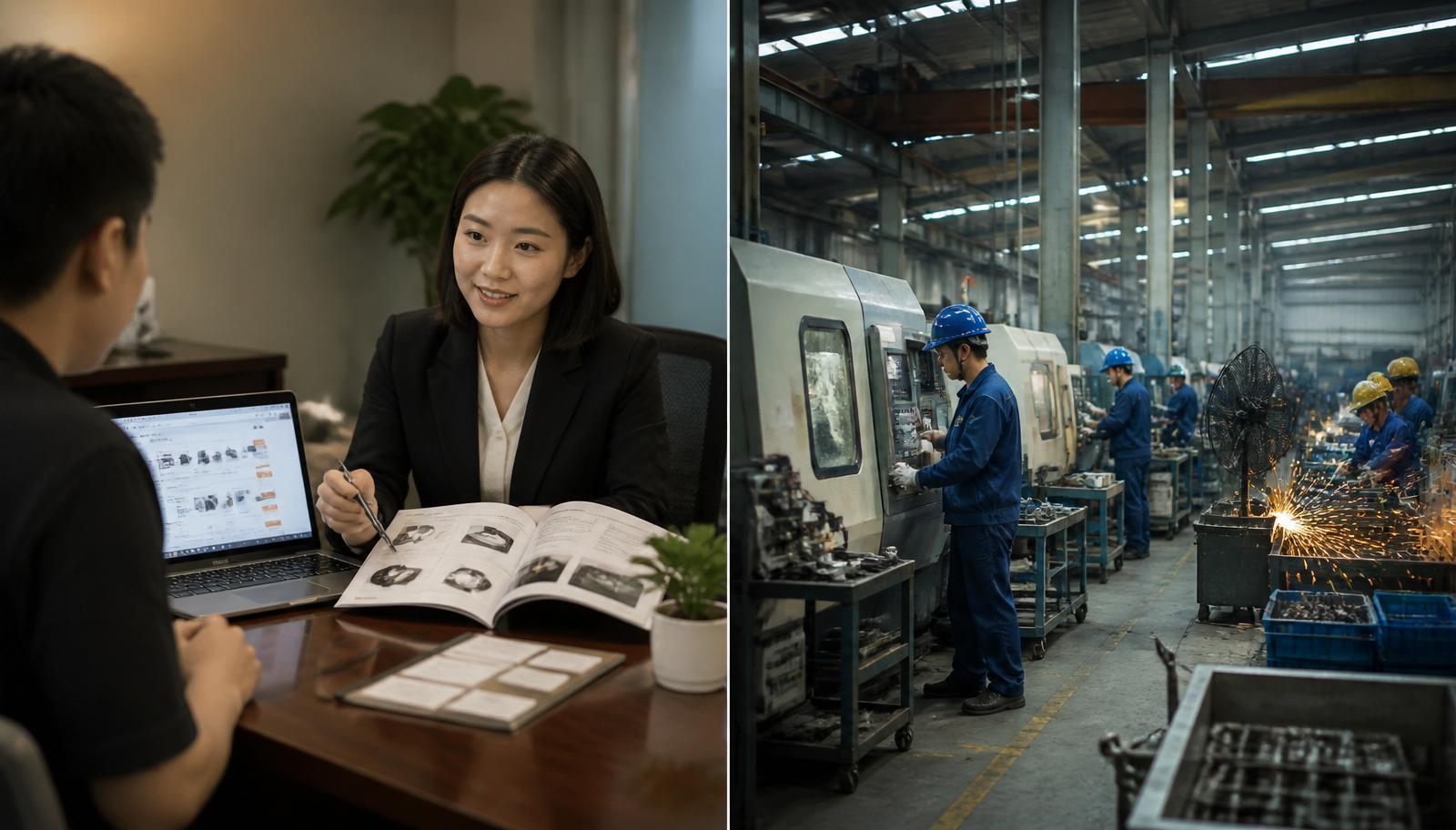
How to Find Real Factories in China (Not Middlemen)
Most "factories" you'll meet online in China are not factories. They're trading companies, sourcing agents, or one-person offices reselling someone else's production. That isn't automatically bad — but you should know which one you're paying, because the price, the quality control, and the risk are all very different.
Here's how to tell the difference, and how to go direct when you want to.
1. Understand what "factory" actually means in China
In Chinese business registrations, a real manufacturer has a business scope that includes 生产 (production) or 制造 (manufacturing). A trading company's scope will read 贸易 (trade), 商贸 (commercial trade), or 进出口 (import/export). This is written directly on the business license — and it is public information. If the license says "trade," the entity is legally a middleman, no matter what their website claims.
2. Skip Alibaba's "Verified Supplier" badge — it doesn't mean what you think
Alibaba's Gold Supplier and Verified badges confirm that the company paid Alibaba and passed a basic on-site check. They do not confirm that the company manufactures the product. A well-run trading company can hold every badge on the platform. Treat the badge as a starting point, not a conclusion.
3. Cross-check on 1688.com
1688.com is Alibaba's domestic Chinese platform, and it's where real Chinese factories sell to Chinese buyers. Prices are lower, listings are in Mandarin, and factories often list their actual production capabilities without the English-language sales polish. If a supplier claims to be a manufacturer but has no 1688 presence — or their 1688 listing shows them selling completely different products — that's a red flag worth understanding.
4. Use the industrial cluster shortcut
China's manufacturing is geographically concentrated. Electronics cluster in Shenzhen and Dongguan. Textiles in Zhejiang and Jiangsu. Furniture in Foshan. Hardware in Yongkang. Ceramics in Chaozhou. If a supplier's registered address is in the correct cluster for their product, that's a positive signal. If a "toy factory" is registered in central Beijing, it's almost certainly a trading office.
5. Ask questions middlemen can't answer quickly
Real factory staff answer production questions instantly. Middlemen have to check with someone. Try these:
- "What's the exact model number of your injection molding machines, and how many do you have?"
- "Can we do a video call from the production line right now?"
- "What's your factory's registered production capacity per month?"
- "Who is your legal representative on the business license?"
A factory sales rep answers in under a minute. A middleman goes quiet, asks to "confirm with the boss," or reschedules the video call.
6. Verify the address on a Chinese map
Copy the Chinese-language registered address into Baidu Maps or Amap (高德地图) and look at the satellite view. Real factories look like factories — large industrial buildings, loading bays, worker dormitories nearby. If the address resolves to an office tower, a residential compound, or a small storefront, you're dealing with a trading office regardless of what they told you.
7. Check the export records
Chinese customs data is available through services like ImportGenius, Panjiva, and 52wmb. Real manufacturers usually have consistent export records under their own name over multiple years. A trading company's records look scattered — different products, different buyers, thin volume. If a supplier claims a decade of exports but customs shows nothing, they're likely exporting under someone else's license.
8. Video call the production line — every time
The single most effective filter is a live, unscripted video call from the factory floor. Not a pre-recorded tour. Not photos. A live walk-through, with your product visible on the line, workers you can see, and the ability to ask the person on camera to point the phone at whatever you want. Middlemen almost never pass this test. When they do agree, the "factory" often turns out to be a workshop they rent for tours.
When a middleman is actually fine
Going direct isn't always the right move. If you're ordering small volumes, mixing products across multiple factories, or entering a new category without local knowledge, a good trading company earns their margin. The problem isn't middlemen — it's paying factory-direct prices to a middleman without knowing it, or trusting quality control to someone whose incentive is to close the deal, not catch defects.
A reasonable playbook: use an agent to get started, verify who's actually making the product, and either negotiate a direct relationship or hire an independent QC engineer once your volume grows. Most factories are happy to deal directly once you're placing meaningful orders.
The one-page checklist
- Business scope on the license: production or trade?
- Registered address in the right industrial cluster?
- Satellite view actually shows a factory?
- 1688 profile matches what they claim to make?
- Export records under their own name?
- Passes a live, unscripted video call?
Six checks. Any one of them will tell you a lot. All six will tell you almost everything.
How we help
FactoryChecker runs these checks — and five more — on any Chinese supplier you send us. We pull the business license from the government registry, verify the production scope, cross-check 1688, examine export records, and confirm the address on a live video call. You get a clear report on whether you're talking to a real factory or a middleman, before you send a deposit.