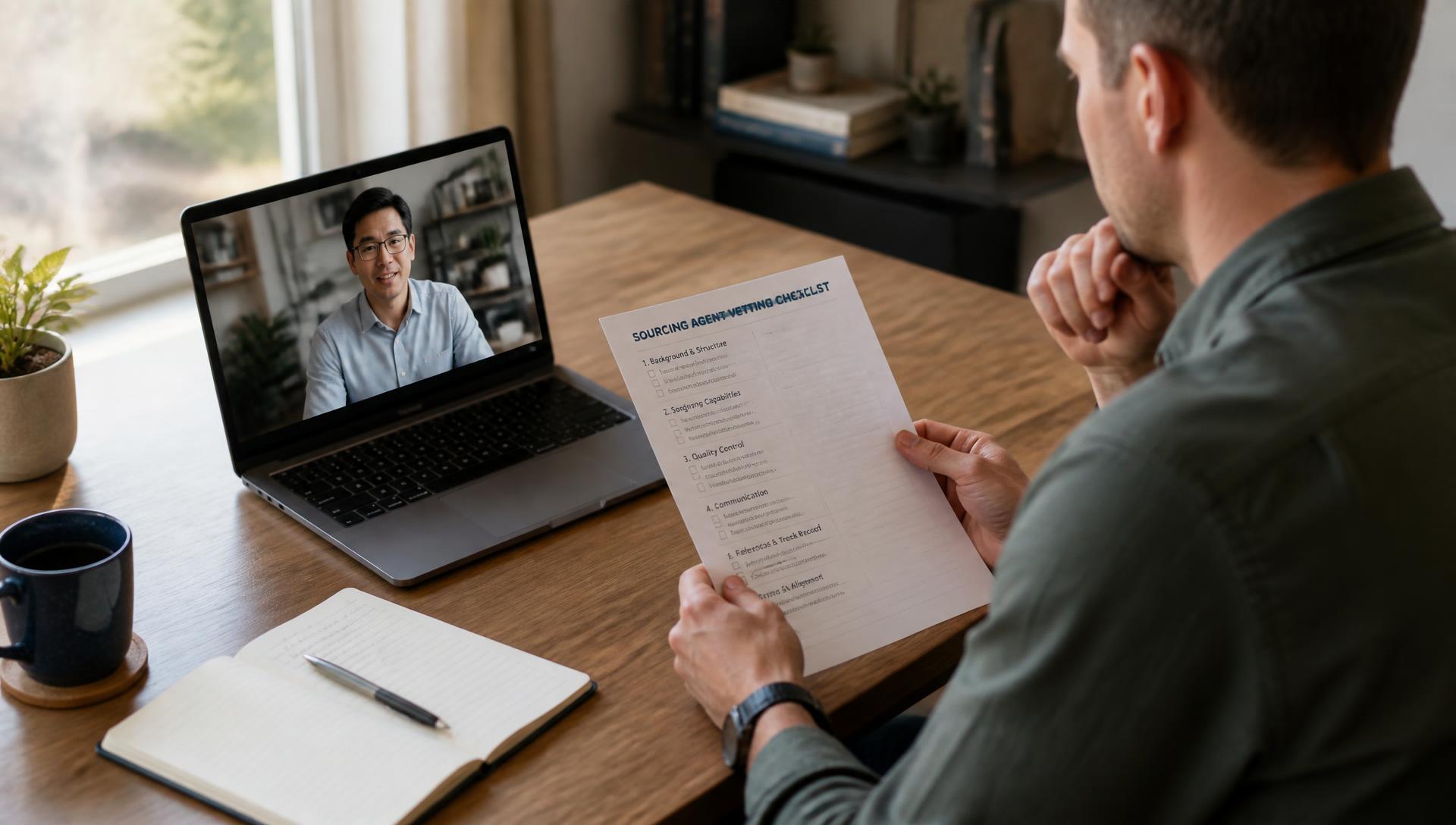
How to Find a Sourcing Agent in China (And Spot the LinkedIn Pretenders)
A good sourcing agent in China is worth several times what they cost. A bad one costs you a hidden markup on every reorder, a supplier you never verified, and — in the worst cases — a deposit that never turns into product. The hard part isn't deciding whether to hire one. It's working out which of the several hundred people offering to be one has actually stood on a factory floor this year.
This is the process we'd use ourselves, written from the perspective of a team that lives in Zhuhai and walks into Guangdong factories most weeks. It started as a LinkedIn post that drew dozens of replies from people claiming to be agents.
First: do you actually need an agent?
Agents earn their fee when there is real complexity to manage. You probably need one if any of these are true:
- Your product needs custom tooling, moulds, or a technical spec that has to be explained in Chinese.
- You are buying from multiple factories and need consolidation, QC, and shipping coordinated.
- Your order value is high enough that a 3–5% fee is cheap compared with the cost of a bad batch.
- You cannot travel to China and need someone physically present when things go wrong.
You probably don't need one if you're placing a small, simple, catalogue order from a supplier you can verify independently. In that case a one-off verification report and a pre-shipment inspection cover most of your risk for a fraction of an agent's annual cost.
Where real sourcing agents actually come from
Almost none of the good ones are found by posting "looking for a sourcing agent" on a social feed. In rough order of how well they work:
- Referrals from other importers in your category. The single highest-yield channel. Ask in category-specific communities — not general business groups — and ask for people who have placed and received orders through the agent.
- Trade shows in China. Canton Fair, Yiwu, and category shows in Shenzhen and Shanghai. Agents who work them are physically in China and usually attached to a real office.
- Freight forwarders and inspection firms. They see who performs. A forwarder who has cleared 200 shipments knows which agents deliver documents on time and which cause chaos at the port.
- Chambers of commerce and consulates. Slow, but the vetting is real, and the paper trail exists if something goes wrong.
- Social platforms. Last resort, and only as a lead source, never as a hiring decision. Treat every reply as an application, not a recommendation.
What a sourcing agent should cost in 2026
There are three normal structures, and one that should worry you:
- Commission, 3–8% of order value. Standard for ongoing relationships. Lower end for large, simple orders; higher for small or complex ones.
- Monthly retainer, roughly $1,000–$3,000. Makes sense when you have continuous work and want the agent's incentives detached from order size.
- Flat fee per project. Good for one-off product launches with a defined scope.
- "Free" sourcing. Not free. The agent is being paid by the factory, which means their loyalty is to the factory, and the cost is buried in your unit price where you cannot see it. Sometimes acceptable — but only if it's disclosed and you price-check independently.
Ask directly: "Do you also receive commission from the supplier?" The honest answer is often "sometimes, and I'll tell you when." The dangerous answer is a flat denial that later turns out to be false.
The eight questions that expose a pretender
You can eliminate most of the pool in one short video call. These questions are not tricks — they're the equivalent of asking a plumber to show you their tools.
- Where are you physically right now? Not "based in Shenzhen" — which district, which building. Ask them to video-call unscripted with the window visible.
- Name three factories you visited in person this month. Real agents do this constantly. Pretenders explain why they haven't been able to visit lately.
- Which categories have you actually shipped? A real answer is narrow ("small kitchen appliances"). "We can source anything" means they source nothing.
- Read this business licence and tell me what's on it. Send a scan of a Chinese 营业执照. If they can't identify the Unified Social Credit Code, the registered capital, and the business scope, they cannot perform basic due diligence.
- What's your company's registration number? A legitimate agency is a registered entity, in China or elsewhere. Individuals invoicing personally with no company behind them leave you with no recourse.
- Who receives my payment for goods? The correct answer is the factory's company account, in the factory's registered name — not the agent's personal account, and not a third-party "consolidation" account.
- Tell me about an order that went wrong. Real agents have three stories with specifics. Pretenders have none, or invent one with no detail.
- Two references from clients who placed real orders. Then call them. Not email — call. "Would you use them again?" tells you more than any profile.
The five types you'll meet online
Not everyone answering your post is bad. But the pool has a shape:
1. The recently-laid-off specialist. Six months ago they were a merchandiser or QC at a real factory. Genuinely useful inside their old category, a liability outside it — and they'll take the work anyway.
2. The English teacher pivoting. Lives in Guangzhou, decent Mandarin, no factory contacts. They'll find your supplier on 1688 — the same one you could have found — and add 20%.
3. The remote "agent" abroad. Everything is handled over WeChat via a partner in Shenzhen. When something breaks, nobody on their side can physically show up.
4. The content farmer. A polished profile full of listicles and "in my years of sourcing…" openers, and no photographs of an actual factory floor. The DMs are a funnel.
5. The real one. On the ground, can name factories visited this month, reads a business licence out loud, and has scars. They rarely need to spam comment sections because their pipeline is referrals.
We wrote about this pattern in more detail after watching one post attract 40 agent replies in a day: Everyone on LinkedIn Is a Sourcing Agent Now.
Put it in a contract
Once you've chosen someone, four clauses do most of the protective work:
- Disclosure of all supplier-side commissions. Written, with the right to terminate if undisclosed payments are found.
- You own the supplier relationship. Factory names, contacts and pricing are disclosed to you, not hidden. Without this, leaving the agent means losing your supply chain.
- Payments go to the factory directly. The agent is paid their fee separately, by you.
- Inspection rights. You can send an independent third party into the factory at any time, at your cost, without the agent's approval.
An agent who resists the last two is telling you exactly where their interests sit.
Verify the factory, not just the agent
This is the step nearly everyone skips, because hiring an agent feels like the due diligence. It isn't. Even a competent, honest agent can propose a supplier with a mismatched business scope, a registered address that turns out to be an apartment, an expired export licence, or an unpaid court judgement. Their check on the factory is only as good as their incentive to look hard — and if they're being paid by that factory, the incentive points the wrong way.
An independent verification separates the two questions: is my agent good, and is this factory real? For $129 we pull the business licence, the Unified Social Credit Code, business scope, registered capital, court and enforcement records, export licence status and bank-account match, and put it in plain English before you wire anything. If a physical walkthrough matters, our on-site factory audit puts one of our team inside the building with a 42-point checklist and photo evidence.
The short version
- Find candidates through referrals, trade shows and forwarders — not comment sections.
- Expect 3–8% commission or a retainer. Distrust "free."
- Run the eight questions on a video call before you send any specs.
- Call two references who actually placed orders.
- Contract for commission disclosure, supplier transparency, direct factory payment, and inspection rights.
- Verify the factory independently, every time, no matter how much you like the agent.
A sourcing agent is a force multiplier, not a substitute for verification. Hire one properly and they'll pay for themselves in the first order. Hire one from a comment thread and you'll pay for it quietly, over years.
Get a factory verified — $129 → See the on-site audit View on LinkedIn ↗