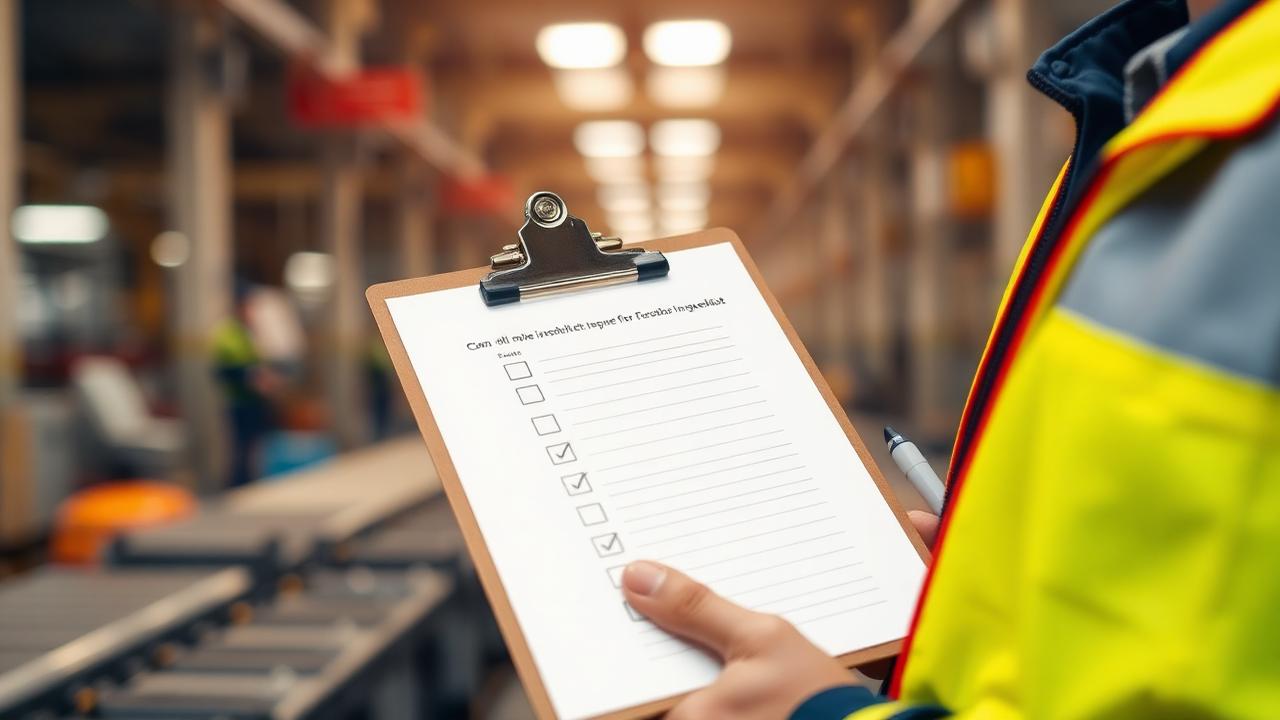
The 42-Point Factory Audit Checklist We Use in Chinese Factories
Most "supplier audit checklists" online are generic procurement templates written by people who have never stood on a factory floor in Guangdong. This is the real one — the list our auditors work through, in the order they work through it.
Below is the checklist our auditors carry into a Chinese factory. It is organised the way an audit actually runs — gate to office to floor to warehouse to paperwork — because that is the order in which a supplier's story falls apart. Copy it, print it, take it with you. If you'd rather we ran it for you, that's the $749 audit.
Before you travel (8 checks)
- Business licence photographed in full, in Chinese — not a translated summary.
- Unified Social Credit Code checked on GSXT: status "存续" (active), not revoked or cancelled.
- Registered capital and date of establishment — a two-month-old company quoting 20 years of experience is a middleman.
- Business scope: does it include manufacturing (生产) or only wholesale/trade (贸易/批发)?
- Court and enforcement records searched for the exact legal entity name.
- Tax credit rating — A/B is fine, D means the company is in trouble.
- Registered address compared against the address they told you to visit. Mismatches are the single most common finding.
- Export licence / customs registration confirmed if they claim to ship directly.
Arrival and site (6 checks)
- Signage at the gate matches the legal entity name, not a brand or a trading arm.
- Whole building or one floor? Photograph the neighbours — shared buildings are normal, but you should know.
- Security log / visitor book — a real factory has one and it has other names in it.
- Vehicles and loading bay activity on the day you arrive.
- Fire exits, extinguishers with in-date inspection tags, marked walkways.
- GPS coordinates recorded and photos geo-tagged.
Production floor (12 checks)
- Machine count by type, photographed, with brand and rough age.
- How many machines are actually running versus idle and dusty.
- Workers present versus the headcount they claimed.
- Is your product category on the line right now — or something unrelated?
- Tooling and moulds: are yours physically there, and who owns them on paper?
- Raw material store: labelled, dated, with supplier documentation.
- Work-in-progress trolleys — a real line always has WIP between stations.
- Rework or defect area, and how full it is.
- Packing area and whether packaging is printed in-house or bought in.
- Warehouse stock of finished goods — for whom, and how old.
- Line speed timed for five minutes to sanity-check the capacity claim.
- Shift pattern, overtime practice, and peak-season capacity headroom.
Quality systems (9 checks)
- Incoming material inspection records for the last three months.
- In-process check sheets, signed and dated, at the stations themselves.
- Final QC station with a defined AQL standard — ask which one.
- Defect log with actual numbers, not a blank template.
- Corrective action reports from a recent problem.
- Calibration certificates for test equipment, in date.
- ISO 9001 certificate: issuing body, certificate number, verified online — not the framed paper.
- Product certifications (CE, FCC, RoHS, CCC, FDA) traced to the certificate holder, which is often not your supplier.
- Lab or test bench on site, and evidence it gets used.
Commercial and people (7 checks)
- Who is the legal representative on the licence, and have you met them?
- Bank account name matches the legal entity exactly — never a personal account.
- Existing export customers and destination markets, with evidence.
- Ask, in Chinese, what percentage of orders are subcontracted out. Answers here are revealing.
- Sub-supplier list for critical components.
- Worker conditions: dormitory, canteen, PPE, and any obviously underage staff.
- Contract terms discussed on site and confirmed against what was emailed.
How to score it
Don't total the ticks. Weight them. Any failure in checks 1–8 or check 37 (bank account) stops the deal — those are fraud indicators, not quality concerns. Failures on the floor are usually negotiable: a factory that can't hit your volume today may be right in six months, and a weak QC log is fixable with your own inspection regime.
The traps that catch experienced buyers are the ones a single visit can hide: rented lines, borrowed machinery, staff drafted in for the day, and a licence belonging to a related company. That's why the paperwork half of this list matters as much as the floor half — and why we always run the desk checks before anyone drives anywhere.
Doing it without flying
If you can't be in Guangdong next week, the same 42 checks can be run by someone who is. Our team in Zhuhai runs this exact list, in Mandarin, and comes back with photos, video and a signed report — from $749, including the desk verification. See what's covered in a factory audit.