Ethical Audits in China: Most Factories Are Not Doing Everything By the Book
We are adding a new service: an in-person ethical audit of your supplier, $598 per man-day, all-inclusive inside Guangdong. This article explains what it is, why the certificate in your inbox is worth very little on its own, and what we actually look at once we are inside the building.
The certificate problem
Ask any Chinese supplier for proof that they are an ethical factory and you will get a PDF within the hour. A BSCI report, an SA8000 certificate, a SMETA summary, a code-of-conduct sheet with your own logo already pasted on top. It looks like an answer. It usually isn't.
Three things go wrong with that PDF, and we see all three regularly:
- It has expired. Certificates run out. Buyers rarely check the date, and suppliers rarely volunteer it.
- It belongs to someone else. The certificate is in the name of a related entity, a former parent company, or the trading arm — not the factory that will actually build your order.
- It was earned for one day. An announced audit is a performance. The floor gets cleaned, the overtime board comes down, the second shift is sent home, and the records that get handed over were printed that morning.
None of this means Chinese factories are bad. China has moved enormously in fifteen years — safety standards, wages and working conditions in the Pearl River Delta today are unrecognisable compared with 2010. But "much better" is not the same as "by the book", and a lot of factories still cut corners, sometimes without particularly realising it is a problem.
What actually goes wrong, in our experience
The failures we find are rarely dramatic. They are ordinary and repetitive:
- Overtime far past the legal monthly cap, recorded as "voluntary" in a second, cleaner attendance file.
- Two sets of payroll numbers — one for the buyer, one for the accountant.
- Social insurance paid for a fraction of the workforce, with the rest hired informally through a labour agent.
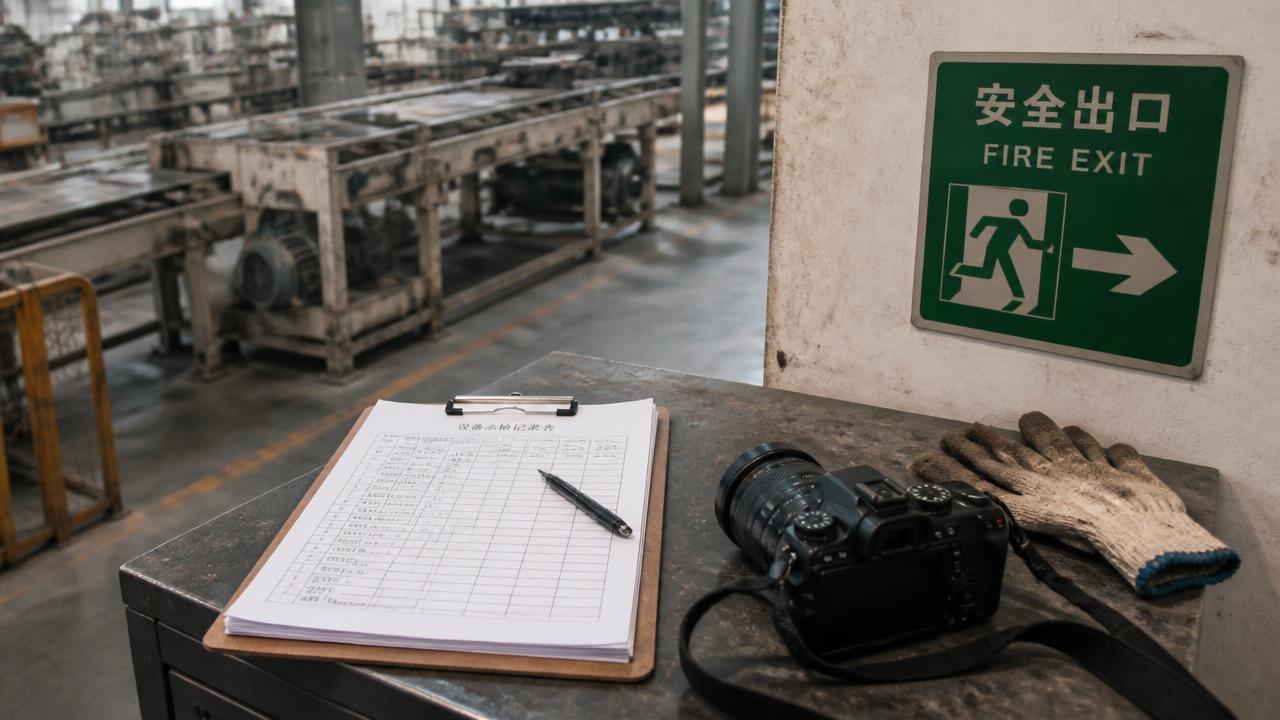
- Fire exits chained, blocked with cartons, or opening onto a stacked storage yard.
- Machine guards removed because they slow the line down, and nobody put them back.
- Chemicals decanted into unlabelled drinking bottles in a room with no ventilation.
- Dormitories over capacity, with no separate fire escape.
- An environmental permit that expired two years ago, or waste going somewhere nobody wants to talk about.
Very few of these are hidden out of malice. Most are what happens when a factory is busy, an order is late, and the person responsible for compliance is also the person responsible for shipping. But they are your problem the moment your brand is on the carton.
What an in-person ethical audit looks like
No nonsense, no scoring theatre. One of our auditors spends a full day inside the factory and does two things: reads the records, then tests whether the floor matches them.
On paper
- Payroll and pay slips, cross-checked against the attendance data rather than taken at face value.
- Working hours, overtime and rest days over a real period, not a sample week chosen by management.
- Labour contracts, social insurance coverage and the use of agency or dispatch workers.
- Hiring and roster records for under-age or forced-labour indicators. We are not police and workers will not hand over ID documents to a stranger — so we look at what the factory's own records show and at what we see on the floor, and we tell you where the evidence stops.
- Health-and-safety training logs, accident records, fire drill records and equipment inspection dates.
- Environmental permits, waste contracts and discharge records.
- Certificates verified at source with the issuing body, not accepted as a PDF.
On the floor
- Fire exits, escape routes, extinguishers and alarms — physically tried, not pointed at.
- Machine guarding, emergency stops, electrical safety, PPE actually being worn.
- Chemical storage, labelling, ventilation, noise and dust.
- Canteen, drinking water, toilets and dormitories, walked and photographed.
- Quiet conversations with workers away from the production line and away from management, in Mandarin.
- A count of who is actually working versus who appears in the records.
You get a signed, photo-evidenced report: every finding rated, every claim backed by an image or a document reference, and a corrective-action list you can put in front of the supplier — or use as a reason to walk away before you place the order.
What we will not do
We will not certify anyone. We are not an accreditation body and we do not issue badges. We will not tell you a factory is "ethical" as a single word, because that is not a thing a one-day visit can prove. What we will do is tell you exactly what we saw, what we could verify, and what we could not — and where a supplier refused access, that goes in the report too. That refusal is usually the most useful line in the document.
Pricing
$598 per man-day, all-inclusive inside Guangdong — transport included, no surprise line items. Most factories need one day; larger sites, multi-building campuses or factories with dormitories usually need two. Outside Guangdong we agree travel and hotel with you in advance rather than adding it to your invoice afterwards.
That is higher than our standard $398 factory audit, and deliberately so: an ethical audit takes longer, involves worker interviews and document cross-checking, and needs an auditor who knows what a coached answer sounds like.
Where to start
If you have not verified the company itself yet, start with the $129 supplier verification report — there is no point auditing labour conditions at an entity that turns out to be a trading company. If you already know who you are dealing with and you need to know how they treat the people making your product, the ethical audit is the next step.
We are buyer-side only. We take no fees from factories, ever, which is the entire reason a pass from us means anything.