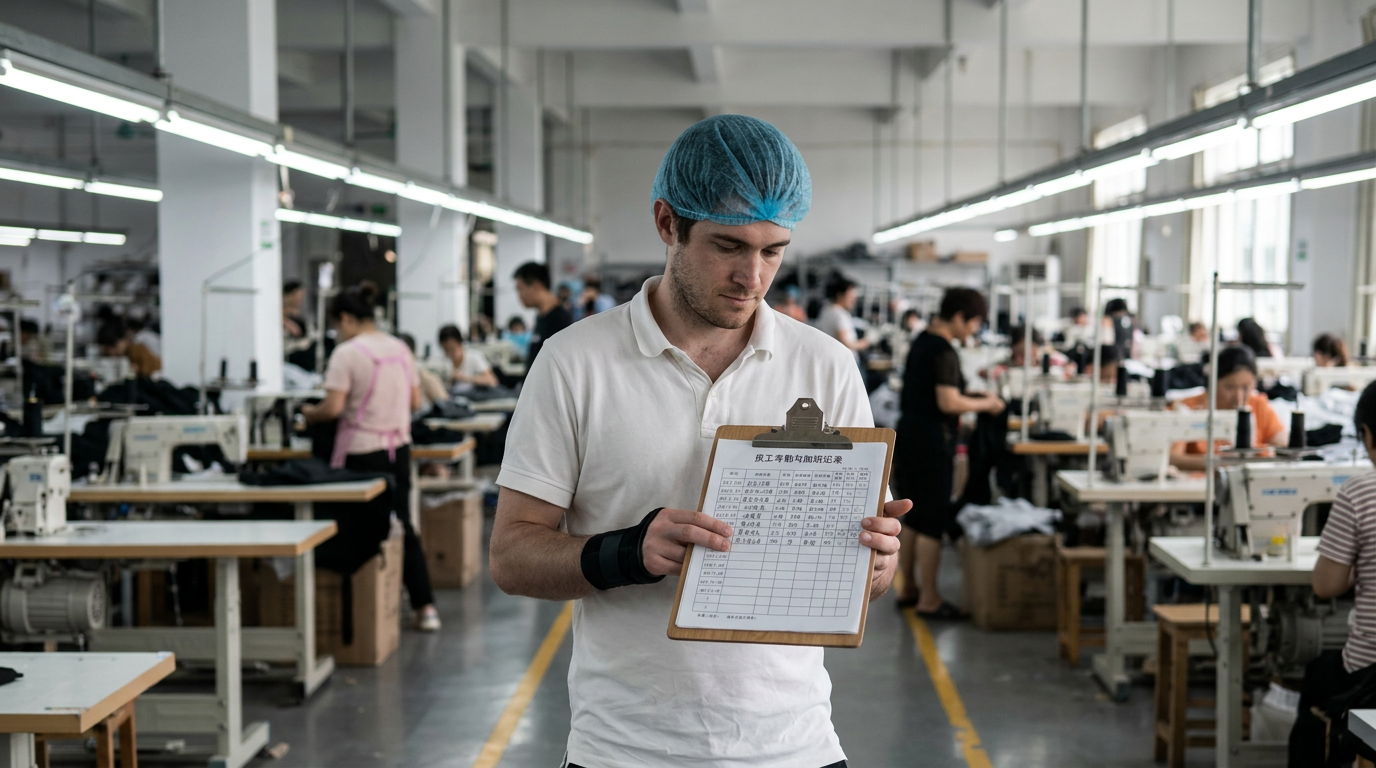
7 Signs a Chinese Factory Is Hiding Labour Violations
None of these signs prove anything on their own. All seven are things we notice within the first hour of walking into a factory, and every one of them is a reason to look harder before your brand goes on the carton.
1. The audit has to be booked for a specific day
A factory with nothing to manage will let you come on Tuesday. A factory with something to manage will negotiate the date — quietly, politely, with good reasons. The line is being retooled. The manager is in Yiwu. Next month is better.
What that date usually buys is a clean floor, a reduced shift and a set of records printed that morning. This is why we push for a short notice window, and why a supplier's reaction to an unannounced or semi-announced visit tells you more than the visit itself.
2. Two versions of the same records exist
The most common finding we write up is not a chained fire exit. It is arithmetic. The attendance file says 176 hours. The payroll says a flat monthly figure that cannot be produced from 176 hours at the local minimum wage. The piece-rate sheet on the wall says something different again.
Legitimate factories have messy records. Factories hiding overtime have tidy records that do not reconcile with each other. When the numbers are too round, too consistent, or handed over as a fresh printout with no history, that is the signal — not the number itself.
3. Headcount on the floor does not match headcount on paper
We count. Workstations occupied, machines running, meals served in the canteen, beds in the dormitory, shoes at the door. Then we compare that with the social insurance list and the payroll.
A gap almost always means agency or dispatch workers hired informally through a labour agent — people who are on your production line but not on anybody's contract. That is the population where under-age workers, unpaid overtime and no injury cover actually show up.
4. Workers are unavailable, chaperoned, or answer identically
We talk to workers in Mandarin, away from the line and away from management. Three patterns tell us we are being handled:
- A manager insists on being present, translating, or "helping" with answers.
- The same worker is produced repeatedly as the representative of every department.
- Answers are word-perfect and identical — the monthly wage, the rest days and the overtime rate delivered in the same phrasing by five people who have never met us.
Coached answers are easy to hear once you know the sound of them. Genuine answers vary, hesitate and contradict each other on detail.
5. A door, a corridor or a floor is off-limits
"That building is another company." "That floor is storage." "The key is with the landlord." Sometimes true. Often it is the second shift, the unpermitted process, the dormitory nobody wants photographed, or the machine with the guard removed.
We write refusals into the report as findings, with the exact wording used. In practice, a refusal to open a door is the single most useful line in an ethical audit report — and the cheapest reason to walk away before a deposit moves.
6. Safety equipment is present but unused
Fire extinguishers with inspection tags filled in for the next six months. PPE stacked in a cupboard, still bagged. Emergency stops that nobody can find. A fire drill log in one handwriting, all twelve months, same pen.
Equipment gets bought for audits. Habits do not. If the extinguisher is unobstructed but the exit behind it is stacked with cartons, you are looking at compliance theatre, and the same logic is likely applied to hours and wages.
7. Certificates arrive fast and belong to somebody else
Ask for proof of ethical standards and a PDF lands within the hour: BSCI, SA8000, SMETA, a code of conduct with your logo already pasted on. Check three things before it means anything:
- The date. Expired certificates circulate for years.
- The legal entity. Very often the certificate names a related trading arm or a former parent company — not the factory that will build your order.
- The address. A certificate for a different site is not evidence about the site you are shipping from.
We verify certificates at source with the issuing body rather than accepting a document. It takes an email and it settles the question.
None of this means Chinese factories are bad
Conditions in the Pearl River Delta today are not the conditions of 2010. Wages, safety and hours have moved enormously. Most of what we find is not cruelty — it is a busy factory, a late order, and a compliance officer who is also the shipping manager. But "much better than before" is not "by the book", and it is your brand on the carton when something goes wrong.
What to do with the seven signs
If you have not confirmed who the company actually is, start there: the $129 supplier verification report tells you whether you are dealing with a real manufacturer or a trading company before you spend anything on a site visit.
If you know the entity and you want to know how they treat the people making your product, that is an in-person ethical audit — $598 per man-day, all-inclusive inside Guangdong, with every finding rated and photo-evidenced. If your concern is product quality rather than labour conditions, the $398 factory audit is the right tool.
We are buyer-side only and take no fees from factories, ever. That is the entire reason a pass from us means anything.